 Cosmos
 blockchains, interoperability, and ATOM
Last updated
Cosmos is a blockchain ecosystem where independently operated networks use a shared software stack and interoperability protocols. The Cosmos SDK helps developers build custom chains, while IBC lets compatible chains exchange tokens and messages. The Cosmos Hub is one blockchain within that ecosystem, and ATOM is its native staking token.
Using an application, staking on the Hub, and building a chain involve different networks and responsibilities. A shared toolkit does not impose one token, security arrangement, or transaction fee across every deployment.
The short version: IBC connectivity lets chains exchange assets and messages, while each deployment determines its own execution rules and security dependencies.
Separate chains with configurable rules
Application-specific blockchains can define their execution logic, validator arrangements, governance, and fee policies through their own configuration. This gives a chain control over how its applications process transactions and how network changes happen. An application can have dedicated block space without sharing execution capacity with every other ecosystem application. In a proof-of-stake deployment, bonded tokens support validator voting power. The same toolkit also supports private and permissioned deployments. Their participation rules come from the deployed network, so using the software does not imply unrestricted public access.
Cross-chain applications still rely on the networks that they contact, so interoperability introduces dependencies alongside that separation.
Application modules and consensus perform different jobs
The SDK assembles a blockchain application from modules that manage defined parts of its state. The bank module handles balances and token sends. Staking manages delegations and validator selection, while governance implements proposals and voting. Developers can combine existing modules with custom logic for the chain's purpose.
CometBFT commonly supplies consensus and peer-to-peer networking. Validators propose blocks and vote on them, while the application determines which state changes are valid.
The Application Blockchain Interface, or ABCI, connects the consensus engine to the application. This separation lets application logic change without rebuilding the entire consensus system. It also assigns different responsibilities to each component: agreement on blocks belongs to consensus, while balance updates and application rules belong to the state machine.
A transaction carries signed messages that request operations on that state. Queries read existing state without submitting a transaction. The installed modules and their configuration determine which operations a particular chain supports.
What can blockchains exchange through IBC?
IBC, short for Inter-Blockchain Communication, supports token transfers and application messages between chains with compatible implementations and configured connections. Its transport machinery authenticates packets, while the receiving application interprets their contents. Relayers carry packet data and proofs between chains. With a light-client connection, verification relies on a compact representation of the other chain's consensus state.
Interchain Accounts extends this model to account control on a participating host chain. A controller can send authorized instructions through the supported IBC application. The host must enable the relevant functionality and permitted messages. Token movement and account control remain different application capabilities, even when both use the same communication protocol.
IBC Classic uses channels to connect applications. IBC v2 changes the connection and routing model, so channel-based instructions do not describe every implementation. IBC Eureka uses IBC v2 for connectivity that includes Ethereum. A usable connection requires the deployed clients and applications to support the intended operation.
Does every Cosmos chain depend on ATOM?
No, independently secured SDK-based chains can operate with their own staking tokens and validators. They can communicate through IBC without making ATOM the fee asset for their local transactions.
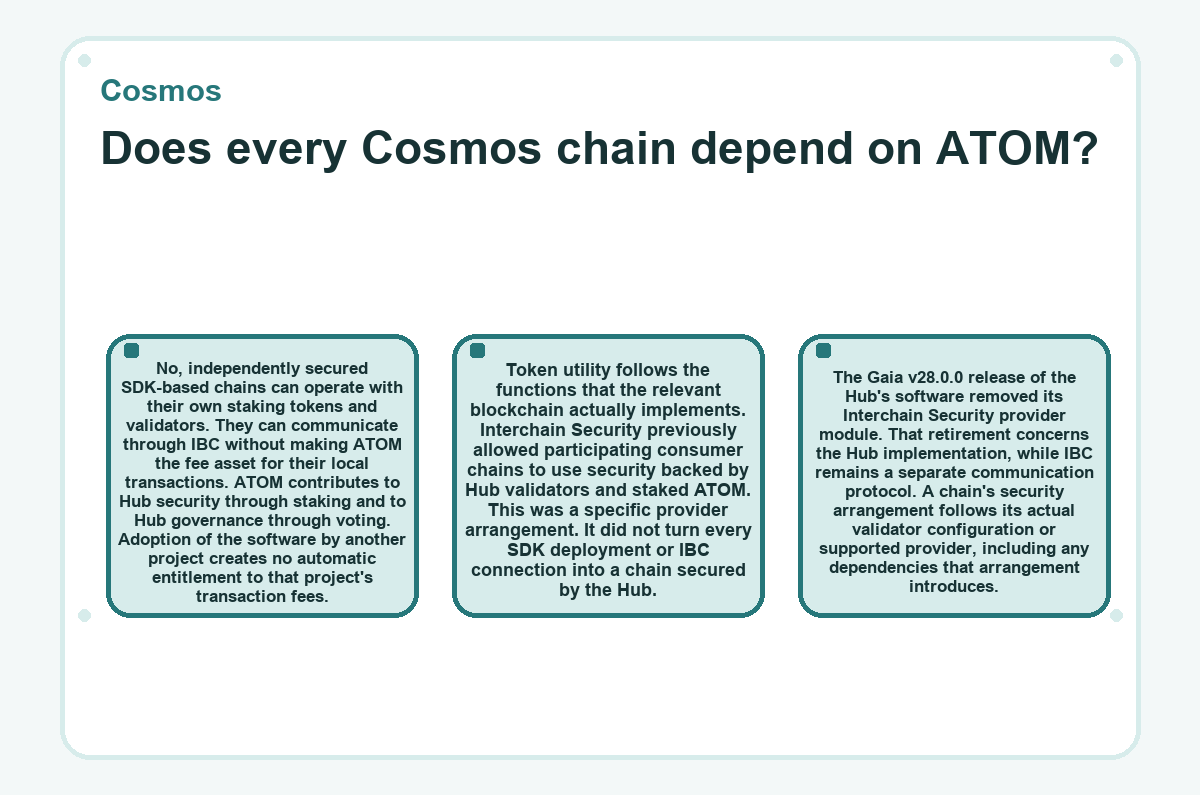
ATOM contributes to Hub security through staking and to Hub governance through voting. Adoption of the software by another project creates no automatic entitlement to that project's transaction fees. Token utility follows the functions that the relevant blockchain actually implements.
Interchain Security previously allowed participating consumer chains to use security backed by Hub validators and staked ATOM. This was a specific provider arrangement. It did not turn every SDK deployment or IBC connection into a chain secured by the Hub.
The Gaia v28.0.0 release of the Hub's software removed its Interchain Security provider module. That retirement concerns the Hub implementation, while IBC remains a separate communication protocol. A chain's security arrangement follows its actual validator configuration or supported provider, including any dependencies that arrangement introduces.
Staking and governance on the Hub
Delegating ATOM locks tokens with a validator. When the validator is in the Cosmos Hub's active set, its delegated stake contributes to consensus voting power, and delegators earn staking rewards after the validator's commission. Rewards reflect factors such as token issuance, fee revenue, and participation; a displayed yield is not a permanent network constant. Bonded tokens are unavailable for ordinary spending. Native undelegation releases them after the applicable unbonding period, whose scheduled completion time appears in the staking record. Validator misconduct can reduce delegated stake through slashing. The validator's operational record and commission policy therefore affect the delegation.
On-chain proposals let bonded ATOM holders participate in Hub decisions. Depending on their contents, proposals can change parameters or schedule software upgrades when the voting rules are met. Deposit requirements, voting periods, and approval thresholds are chain parameters. Governance on another SDK-based network concerns that network's own rules and voting asset.
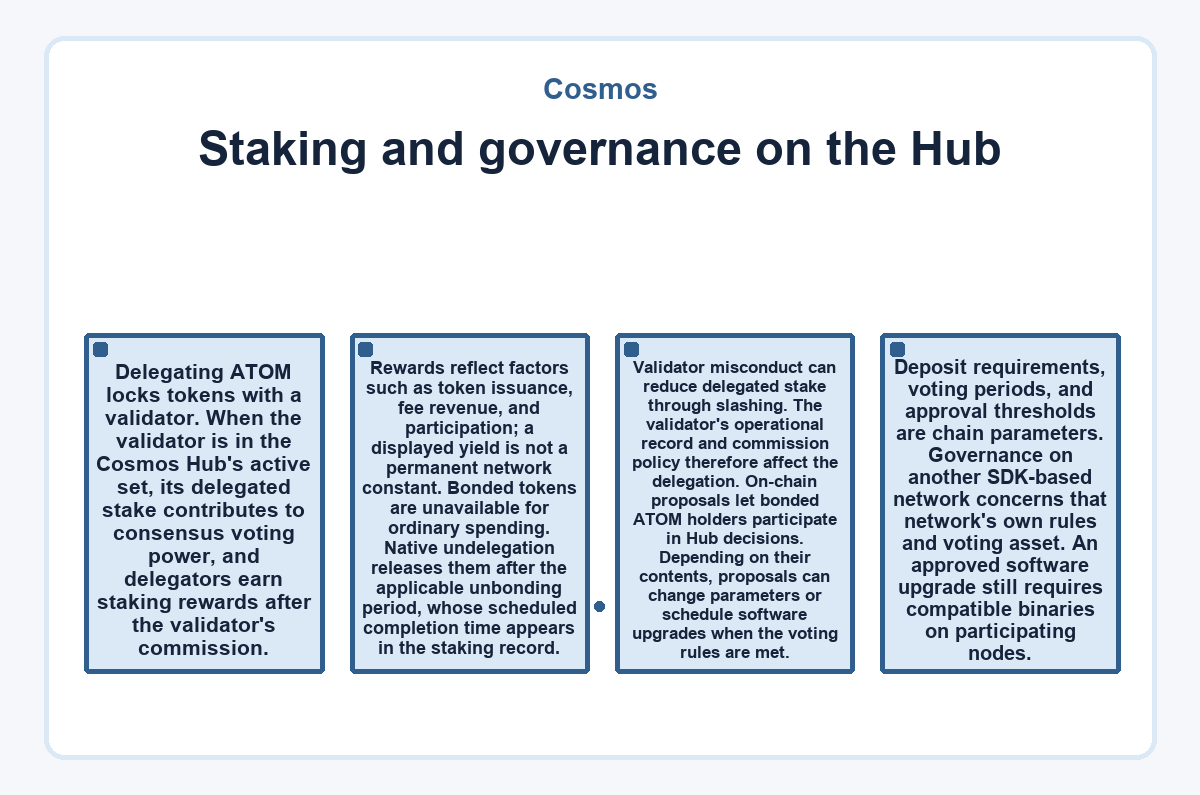
An approved software upgrade still requires compatible binaries on participating nodes.
Fees and token identity follow the selected chain
A transaction's cost follows the chain where it executes, its gas requirements, and the fee policy that the network applies. Gas measures the computational work performed by the transaction. Accepted fee assets differ across deployments. Holding a transferable asset does not necessarily provide the asset needed for a later transaction on the destination chain. Cross-chain interfaces can add relaying or service charges under their own arrangements, so the transfer amount and the fee amount need separate interpretation.
Under the ICS-20 transfer model used with IBC Classic, a token sent away from its source is escrowed and a representation is issued on the receiving chain. Returning along the corresponding path reverses that representation through burning and release from escrow. The denomination trace records the transfer path, which helps identify what the receiving balance represents.
Different traces can produce distinct denominations even when wallets display the same ticker. An application's accepted denomination matters for trading or other token uses. Transporting a token also does not automatically make it the receiving chain's native staking asset.
Security assumptions and public transaction data
CometBFT requires precommits representing more than two-thirds of total voting power to commit a block. Its protection against conflicting commits assumes less than one-third of voting power acts maliciously. Cross-chain security also depends on each connection's verification model and the participating chains. Public-ledger balances and transactions can be inspected, and IBC does not automatically add privacy. Private deployments need their own access and disclosure configuration. A compromised signing key can authorize valid transactions despite correctly functioning consensus.
Chain ownership or smart contracts on an existing network
Building a chain gives developers protocol-level control and the responsibility to operate the network that uses it. The work includes module integration, validator arrangements, and coordinated upgrades. Deploying a smart contract on an existing compatible chain uses that chain's execution environment and security. The contract must respect the host's rules, fees, and deployment permissions. This choice turns on how much control the application needs over the underlying protocol. A custom fee model or chain-wide execution rule may justify a separate chain; contract logic can fit within an existing runtime.
CosmWasm enables WebAssembly smart contracts on chains that integrate its module. Cosmos EVM embeds an Ethereum Virtual Machine in an SDK-based chain, supporting Solidity contracts and Ethereum tooling. These are configured execution options. An SDK-based network does not inherit every smart contract capability merely by using the framework.
Osmosis demonstrates exchange-focused chain design; dYdX uses application-specific blockchain software for perpetual futures trading. Their application rules belong to their respective networks.
A compatible transfer from submission to receipt
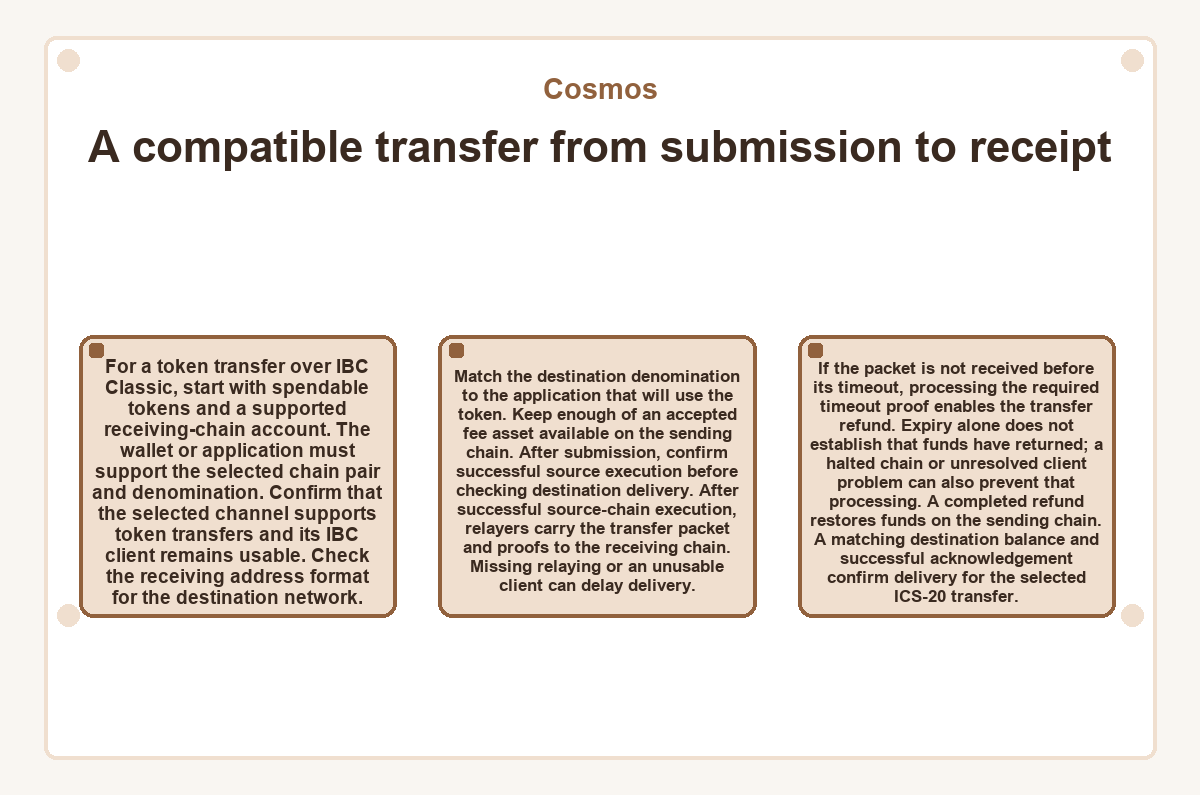
For a token transfer over IBC Classic, start with spendable tokens and a supported receiving-chain account. The wallet or application must support the selected chain pair and denomination.
- Confirm that the selected channel supports token transfers and its IBC client remains usable.
- Check the receiving address format for the destination network.
- Match the destination denomination to the application that will use the token.
- Keep enough of an accepted fee asset available on the sending chain.
- After submission, confirm successful source execution before checking destination delivery.
After successful source-chain execution, relayers carry the transfer packet and proofs to the receiving chain. Missing relaying or an unusable client can delay delivery. If the packet is not received before its timeout, processing the required timeout proof enables the transfer refund. Expiry alone does not establish that funds have returned; a halted chain or unresolved client problem can also prevent that processing.
A completed refund restores funds on the sending chain. A matching destination balance and successful acknowledgement confirm delivery for the selected ICS-20 transfer.
Cosmos: the short answers
Why can an ATOM exchange deposit require a memo?
An exchange can require a memo to identify your account when customers share a deposit address. The requirement comes from the receiving platform, and ordinary self-custody transfers generally do not need this account identifier. A correct blockchain address alone may therefore be insufficient for the exchange to credit the intended customer.
Can delegated ATOM move directly to another validator?
Native redelegation can move delegated ATOM to another validator without first returning it to a spendable balance. An unfinished incoming redelegation prevents the delegator from redelegating onward from the receiving validator. A new redelegation also fails when the delegator's outstanding entries for the selected validator pair have reached the chain's limit. During the redelegation period, tokens can remain exposed to slashing for the original validator's earlier misconduct.
What happens if I do not vote on a Cosmos Hub proposal?
A delegator who does not submit a vote inherits the votes of their validators for the corresponding delegated voting power. Submitting a personal vote overrides that inherited choice for their stake. The vote must arrive during the proposal's voting period; a liquid ATOM balance alone does not provide bonded voting power.
Is the Cosmos SDK free to use?
The standard open-source Cosmos SDK is available under the Apache 2.0 license. Optional Cosmos Enterprise modules have different terms: their published code uses a Source Available Evaluation License, and production use requires an Enterprise License. Running a blockchain also has infrastructure and operational costs beyond access to the software.
Does a failed Cosmos transaction still incur a fee?
A transaction included in a block can incur fees even when its message execution fails. In standard SDK processing, fee deductions occur before application messages execute, and those deductions can persist when message changes are rolled back. A rejected signing request in a wallet does not submit an on-chain transaction.